
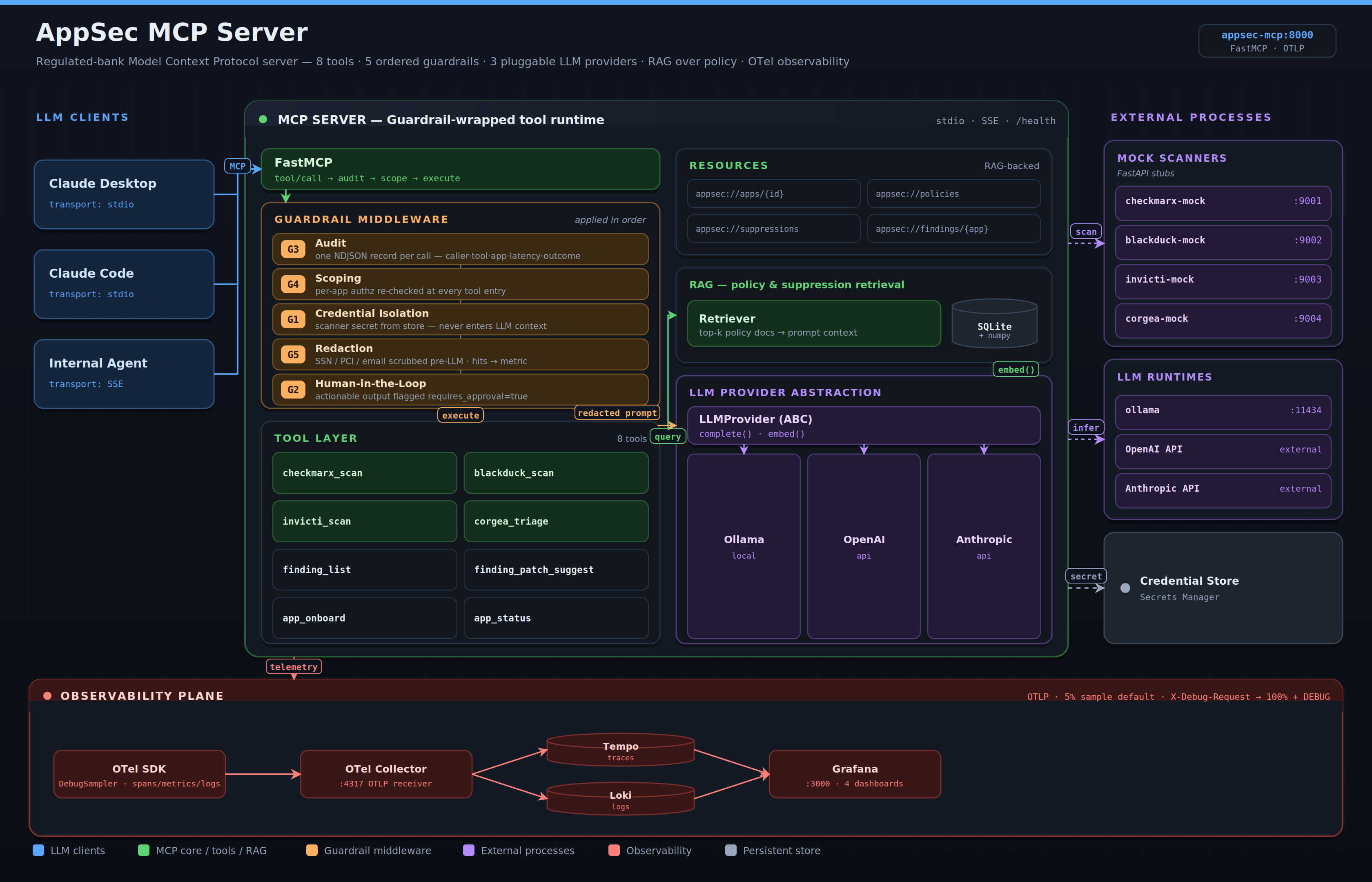
8 tools. 5 ordered guardrails. 3 pluggable LLM providers (Anthropic, OpenAI, Bedrock). End-to-end OpenTelemetry observability into Tempo/Loki/Grafana.
View the portfolio →Your CISO needs to sign off. Your engineers want to ship. That gap is the engagement.
Be Digital advises technology and security teams at banking, insurance, asset management, and healthcare payer organizations on how to deploy generative AI systems that satisfy compliance requirements without stalling the engineering roadmap.
Start a conversationDeploying generative AI that drafts, monitors, and scans inside a regulated environment is not a model selection problem — it is a controls problem. Banking institutions under SR 11-7, insurance carriers with NAIC guidance, and healthcare payers subject to HIPAA all operate under model risk management frameworks that require explainability, auditability, and documented human oversight. Dropping an LLM into a workflow without addressing those requirements creates regulatory exposure that the security team will discover at the worst possible time.
The Model Context Protocol (MCP) server built for this advisory practice is a reference implementation of exactly those controls. It runs eight tools through five ordered guardrails — input sanitization, prompt injection detection, policy enforcement, output filtering, and rate limiting — before any response reaches the application layer. Three pluggable LLM providers (Anthropic, OpenAI, and AWS Bedrock) mean you are not locked into a vendor, and you can route traffic based on data residency requirements without rewriting the integration.
End-to-end OpenTelemetry observability — traces into Tempo, logs into Loki, dashboards in Grafana — means every inference request is a structured event with a trace ID. Each guardrail and tool call runs as a child span under the request's parent span, so the propagated trace context stitches the whole pipeline into one timeline, and the same trace ID is injected into every log line so traces and logs join up instead of living in separate silos (OpenTelemetry instrumentation). That trace is your audit trail. When a regulator asks what the model was asked, what guardrails fired, and what was returned, you answer with correlated logs rather than reconstruction.
The advisory engagement applies those patterns to your specific system: your data classification, your approval workflows, your existing security tooling. The goal is a deployment your CISO can sign off on without blocking the team that built it.
8 tools. 5 ordered guardrails. 3 pluggable LLM providers (Anthropic, OpenAI, Bedrock). End-to-end OpenTelemetry observability into Tempo/Loki/Grafana.
View the portfolio →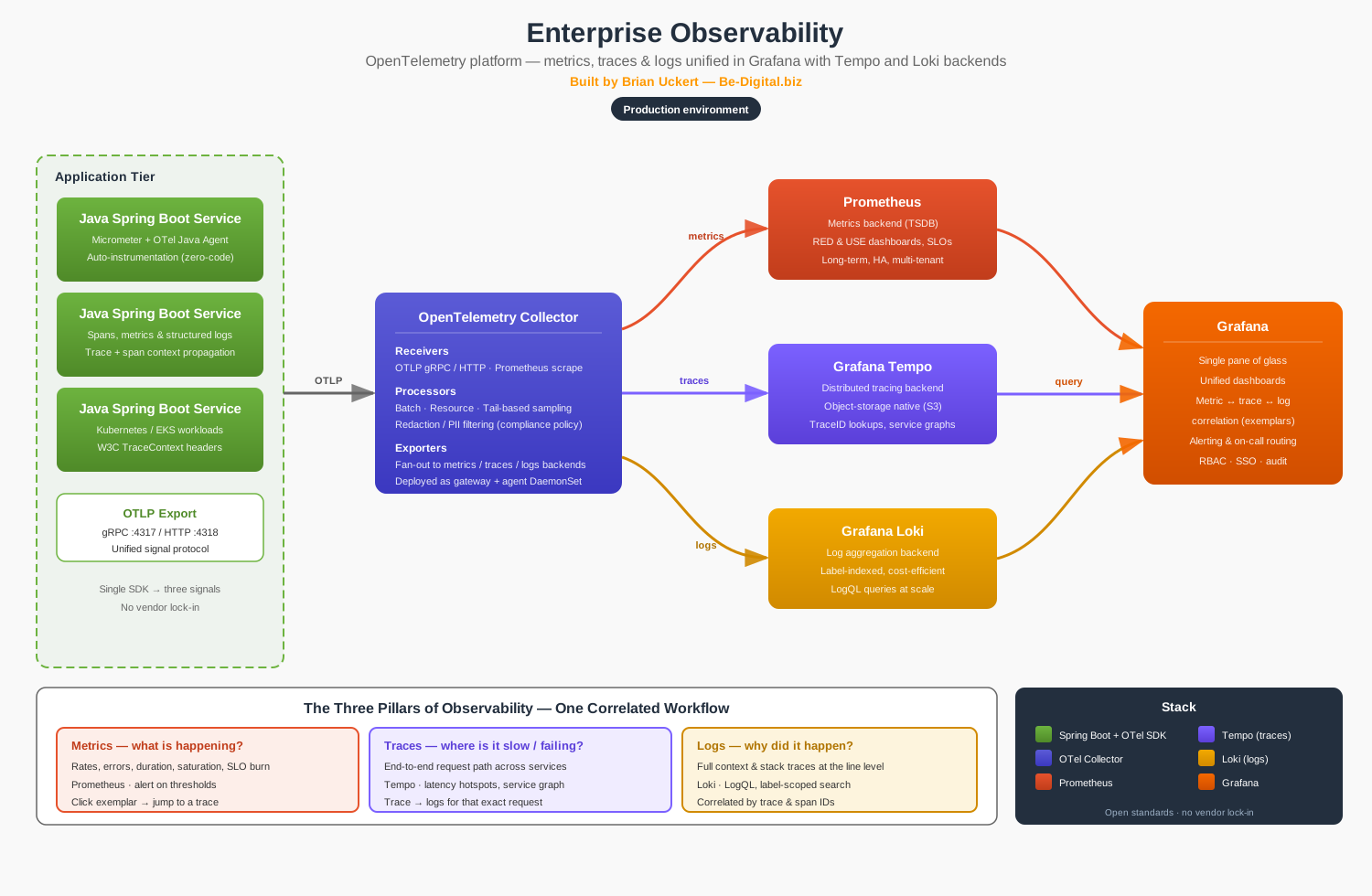
End-to-end OpenTelemetry instrumentation — parent/child spans across an ordered guardrail pipeline, trace-ID-correlated logs into Tempo and Loki, and Grafana dashboards. One correlation ID ties every span, trace, and log line together.
View the portfolio →Reference implementations and case studies from enterprise platform engineering and security engagements.
Enterprise GitOps platform on EKS — multi-cluster DEV/PROD isolation, ArgoCD, Terraform, Karpenter, and a 352-test validation suite.
Self-service developer portal implementation for a regulated enterprise.
Platform maturity case study — from reactive operations to self-service.
GitLab migration, tool-agnostic guardrails enforced at CI, and an AWS baseline scoped to run without dedicated infra headcount.
8 tools, 5 ordered guardrails, 3 pluggable LLM providers, end-to-end OpenTelemetry observability.
Field notes on progressive disclosure — how Claude Skills change the economics of agentic coding work.
Part two — wiring the playbook across a polyglot platform: memory load order, path-scoped rules, and managing the live context budget.
Structured 4-week proof of concept — org setup, repo-trained customizations, baseline metrics, and a go/no-go decision package.
91% SonarQube coverage using Claude Opus 4 + GitHub Copilot with three enforcement layers that make production edits architecturally impossible.
A Copilot-only, cost-aware workflow that raises Java test coverage to 91% — autonomous agent loop, defense-in-depth guardrails, and token engineering.
Field notes on the economics of agentic AI that drafts and scans: why token cost grows every turn, and the four levers that cut it.
Copilot vs Claude Code — how each tool builds context, what costs tokens, and the levers that cut it.
A Phoenix Project-style narrative on why token cost is a work-in-progress problem, not a model problem. Six levers, in order.
What your coding assistant costs vs whether the service is up — in plain terms, applied to Copilot and Claude.
What Orbit's SDLC graph does for agents, where it helps, and the code it won't read.
Non-human identity sprawl at scale, supply-chain attacks on the dev process, and the identity-first playbook.
HashiCorp Vault across Dev/UAT/PRD with business divisions isolated by namespace — cluster topology, delegate-admin policy, and BC/DR.
From legacy delivery to a team-owned, self-service platform that is agentic-native and compliant by default. One-page briefing with layered architecture and phased migration.
Executive-director-level background spanning platform engineering and security.
Engagements start at $18,000/month. Scope and cadence defined at kickoff.
Monthly retainer
Time-boxed engagement
The gap between what engineers want to deploy and what security will approve is a scoping problem, not a technology problem. Let's close it.
Start a conversation